4K Projectors, the Right Screen for Razor-Sharp Home Cinema
Entering the world of extremely
high-resolution large-screen projection marks a significant milestone for every film lover, series fan
and home cinema enthusiast. A modern 4K
projector delivers such immense depth of detail and plasticity that
conventional televisions simply cannot compete in direct comparison with large screen diagonals.
However, for this visual experience to be transported flawlessly, an outstanding
projector alone is not enough. The light leaving the lens must hit a
surface that is precisely designed to reflect this extreme pixel density
faithfully and without loss of quality.
At Leinwandbau.info, we support
you with sound technical expertise to get the maximum potential out of
your home cinema setup. Anyone who tries to operate a highly developed UHD
projector on a simple, uneven woodchip wallpaper or an
inferior, coarsely woven fabric wastes a significant
portion of the image sharpness, contrast, and color brilliance. Our comprehensive
guide will lead you deep into the subject, awaken your fascination for the
perfect picture, and show in detail why the careful coordination of all
components is the most important key to unforgettable movie nights in your
own home.



4k Beamer im Überblick, was die Auflösung wirklich bringt
4K Projectors at a Glance: What Resolution Really Brings
The introduction of Ultra HD resolution has fundamentally revolutionized modern home entertainment. While Full HD structures dominated in classic cinemas for years, a 4K home theater projector system now quadruples the pixel density to an impressive 3,840 x 2,160 pixels. This enormous information density means that even on very large projection surfaces, no distracting stair-stepping effects, pixel structures, or visible grids are perceptible to the human eye. The image appears completely seamless, organic, three-dimensional, and absolutely true to life.
However, relevant professional reports and individual 4K projector tests regularly show that resolution is not simply resolution. The market primarily distinguishes between projectors with a native 4K chip and models that generate an Ultra HD image using highly developed pixel-shifting technology (XPR). A native 4K projector uses a panel that physically has the full 8.3 million pixels. These devices represent the technological cutting edge, offer the absolutely sharpest demarcation of individual image details, and guarantee uncompromising image stability, which is particularly evident with fine textures, patterns, and fonts. Pixel-shifting projectors, on the other hand, move the mirrors of a Full HD or WQXGA chip back and forth so rapidly that a full Ultra HD image is also created for the human eye. This variant is now so technologically mature that it represents an excellent and at the same time budget-friendly alternative.
In addition to the pure pixel count, a modern 4K projector and projector setup benefits massively from extended color spaces and dynamic contrasts. Technologies like HDR10 (High Dynamic Range) and Dolby Vision ensure that the brightness differences between the darkest and brightest areas of an image are precisely balanced. A digital lawn glows in rich green, while in the nocturnal shadows of an exciting blockbuster, no nuances are lost in uniform gray. However, to make these fine brightness gradations visible in the living room without distracting reflections or loss of detail, the interaction with ambient light comes into focus.

4k Projector and Screen: Why Their Interaction Is Crucial
A high-end projector delivers a fantastic light signal, but the final image quality only emerges from the physical reflection behavior of the surface on which this signal impinges. If the screen texture is not precisely matched to the fine pixel matrix, the advantage of Ultra HD resolution is almost entirely lost, as the screen literally swallows up the fine details.

Which screen is suitable for a 4k projector
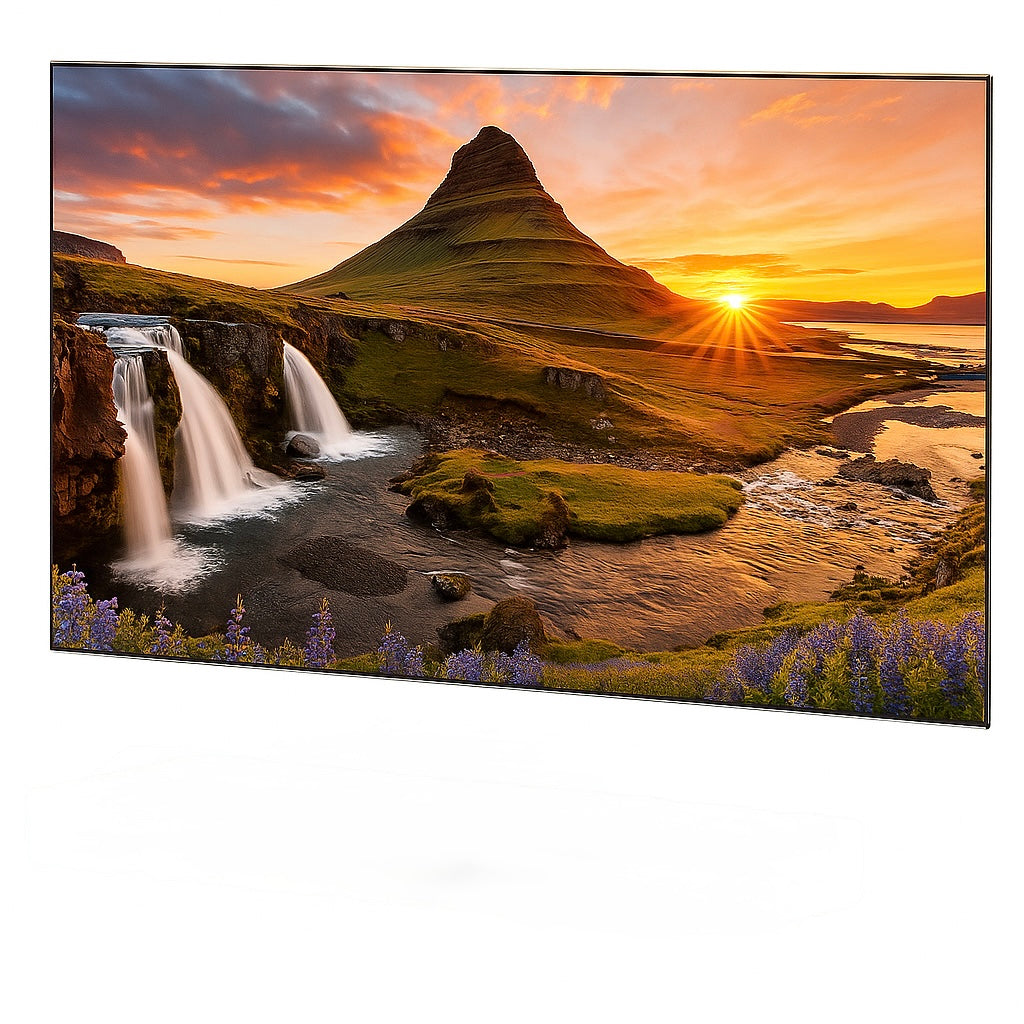
When answering the question of which screen is the right choice for 4k projector systems, you primarily need to examine the material properties and structure. A high-quality 4k projector screen is characterized by a completely smooth, homogeneous fabric surface. While older fabrics for standard resolutions often had a noticeable weave structure, modern projection fabrics use microfine coatings.
This fine structure prevents the occurrence of the dreaded moiré effect, where the pixel grid of the projector collides with the weave pattern of the corresponding projector screen and creates disturbing, wave-like interference patterns. An optimally matched 4k projector screen ensures that each of the 8.3 million pixels is precisely reflected back to the viewer's eye, thereby fully preserving the native sharpness of the projector.
Gain, screen type, and viewing distance
The gain factor describes the reflection behavior of the projection screen. For an optimized home theater in a dedicated, completely dark room, a matte white screen with a neutral gain value of 1.0 is usually the perfect choice, as it diffuses light evenly in all directions and guarantees a maximum viewing angle for all seats. However, if the setup is in a normal living room with bright walls and windows, a home cinema screen is needed that effectively absorbs scattered light.
In such environments, gray screens or contrast-enhancing multi-layer systems are used. The viewing distance plays a mathematical role here: Since the image of a 4K projection is extremely sharp, you can move significantly closer to the screen than in the days of Full HD, without the image pixel grid being distracting. This allows spectacularly large image diagonals even in compact living spaces.


4k Projector in a Home Cinema, Ideal Image Size and Viewing Distance
The sizing of the projection surface is a decisive factor in whether a true cinema feeling arises or whether the image overstrains the eye. For the typical 4k projector living room scenario, an image diagonal of 120 inches has emerged as the absolute gold standard. A system with a 4k 120-inch projector offers a pure viewing width of approximately 2.65 meters. With a modern Ultra-HD projector, the ideal viewing distance is about 1.2 to 1.5 times the image width.
This means that with a 120-inch screen, you can enjoy an absolutely perfect, immersive movie experience from a distance of approximately 3.20 to 3.80 meters, without individual pixels becoming visible. If you choose the image size too small, you lose the advantage of the high resolution, as the human eye can no longer resolve the fine differences at a distance. If, on the other hand, you choose the image too gigantic for a narrow room, viewers will have to constantly move their heads back and forth to follow the action, which leads to fatigue in the long run. A precise coordination between room width, seating position, and the desired image diagonal is therefore the most important basis for any professional home cinema planning.

Native 4k Projectors, Laser and Short-Throw Compared
Today, the high-end projector market is divided into various technological concepts, each offering specific advantages depending on the intended use and room characteristics. While classic lamp projectors are increasingly receding into the background, modern, maintenance-free light sources dominate the scene.
A 4K laser projector uses long-lasting laser diodes instead of a classic UHP lamp. This technology offers two invaluable advantages: extremely long durability, usually over 20,000 hours of maintenance-free operation, and absolutely constant light output throughout its entire lifespan. In addition, laser light sources enable instantaneous switching on and off without annoying warm-up phases. In terms of color, these systems, especially as RGB triple lasers, achieve color spaces that go far beyond the conventional standard and display cinema-quality, deeply saturated color nuances.
4k Short-Throw Projector and the matching ALR Screen
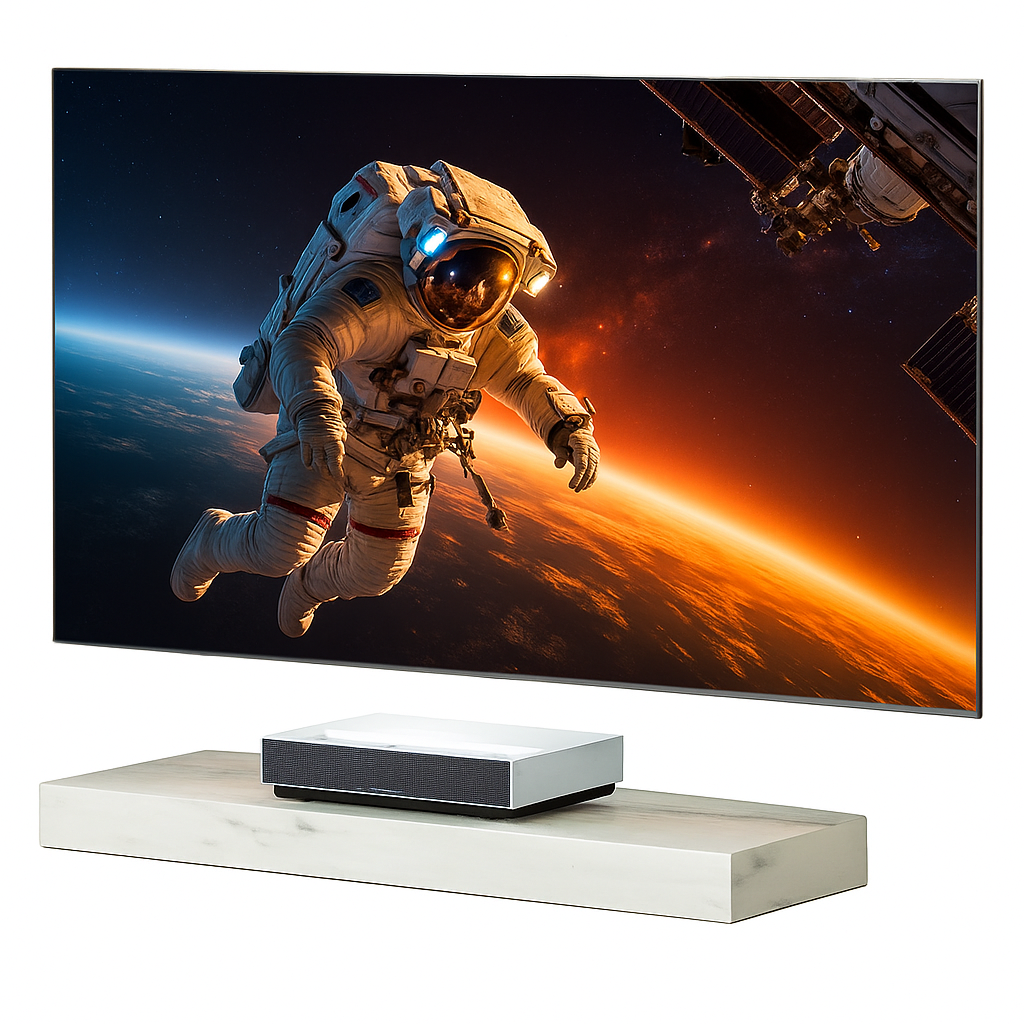
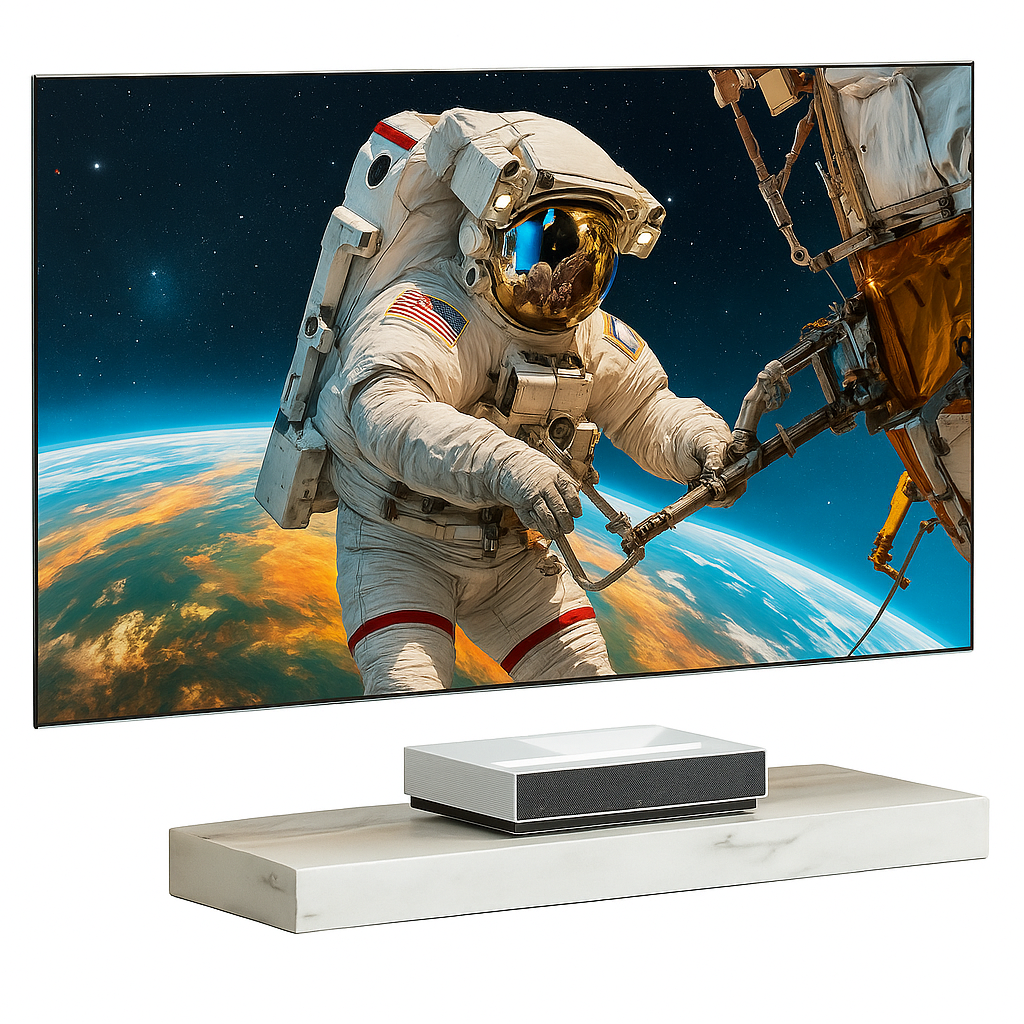
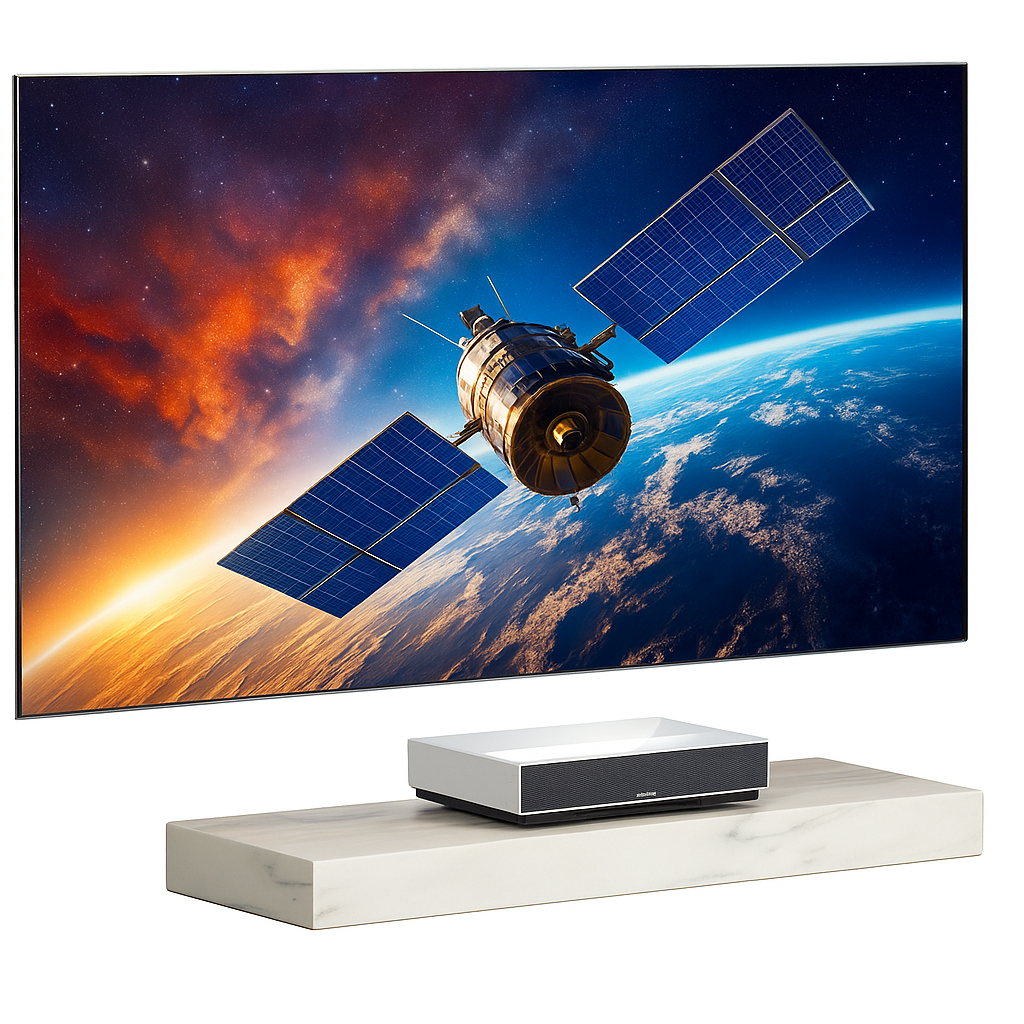
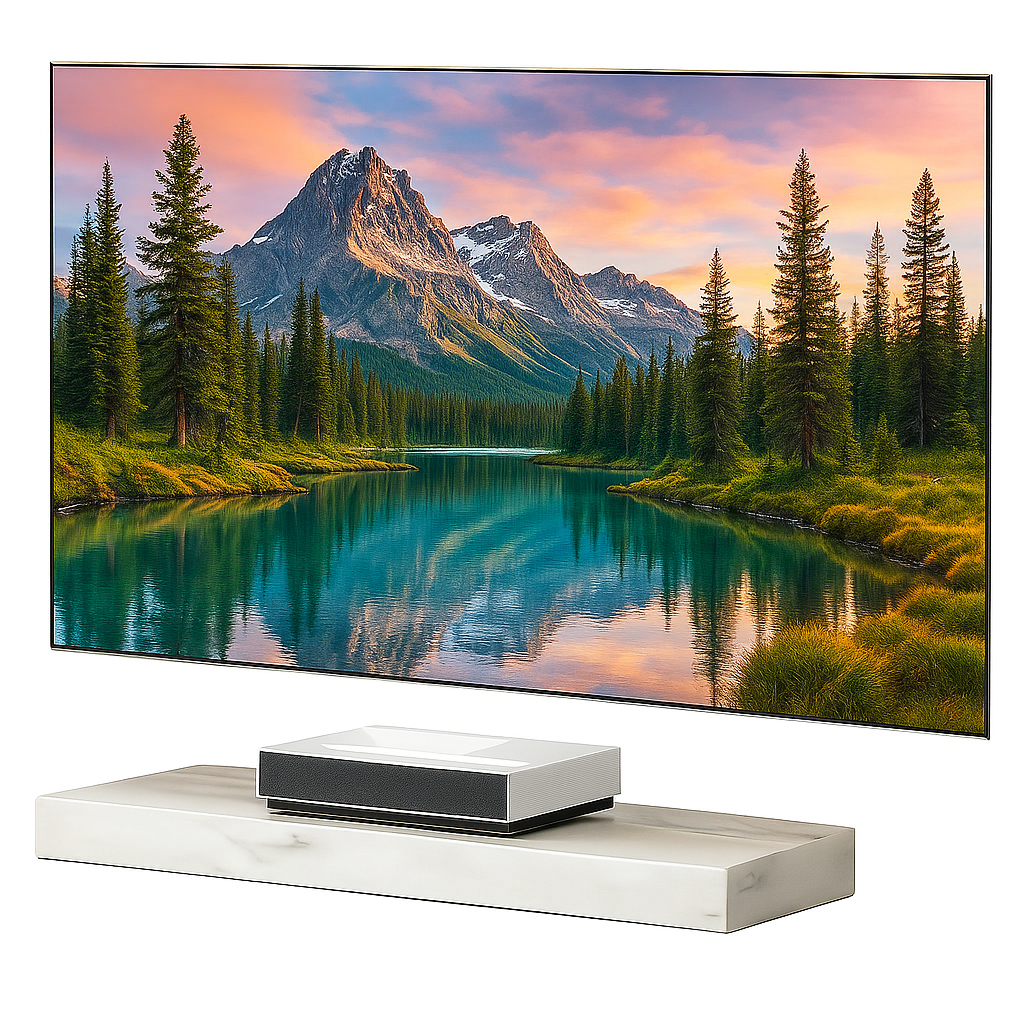
A particularly innovative class of devices is the 4k short-throw beamer (also known as an ultra-short-throw projector or laser TV). These devices are not mounted far back in the room on the ceiling, but rather placed like a classic TV set directly on a sideboard a few centimeters in front of the wall. Since the light in this design is cast onto the wall at an extremely steep angle from bottom to top, the use of a standard screen is physically impossible; it would reflect the light straight to the ceiling.
The solution for this setup is a special ALR screen for bright rooms (Ambient Light Rejecting). These screens feature a microscopically small, sawtooth-like lamellar structure. It is precisely aligned to direct the light coming steeply from below from the short-throw projector directly forward to the viewer. At the same time, distracting ambient light from windows or ceiling lamps is completely absorbed or diverted. The combination of a modern short-throw projector and a screen for short-throw projectors thus enables a high-contrast, brilliant image even on a bright afternoon in a light-filled living room.
4k Projector with Screen as a Set: What to Consider When Buying
For many customers, purchasing a perfectly matched bundle is the safest and most convenient method to rule out technical incompatibilities from the outset. A pre-configured 4k projector home cinema set offers you the invaluable advantage that experienced experts have already precisely matched the projector's light output, contrast value, and the screen's reflection behavior.
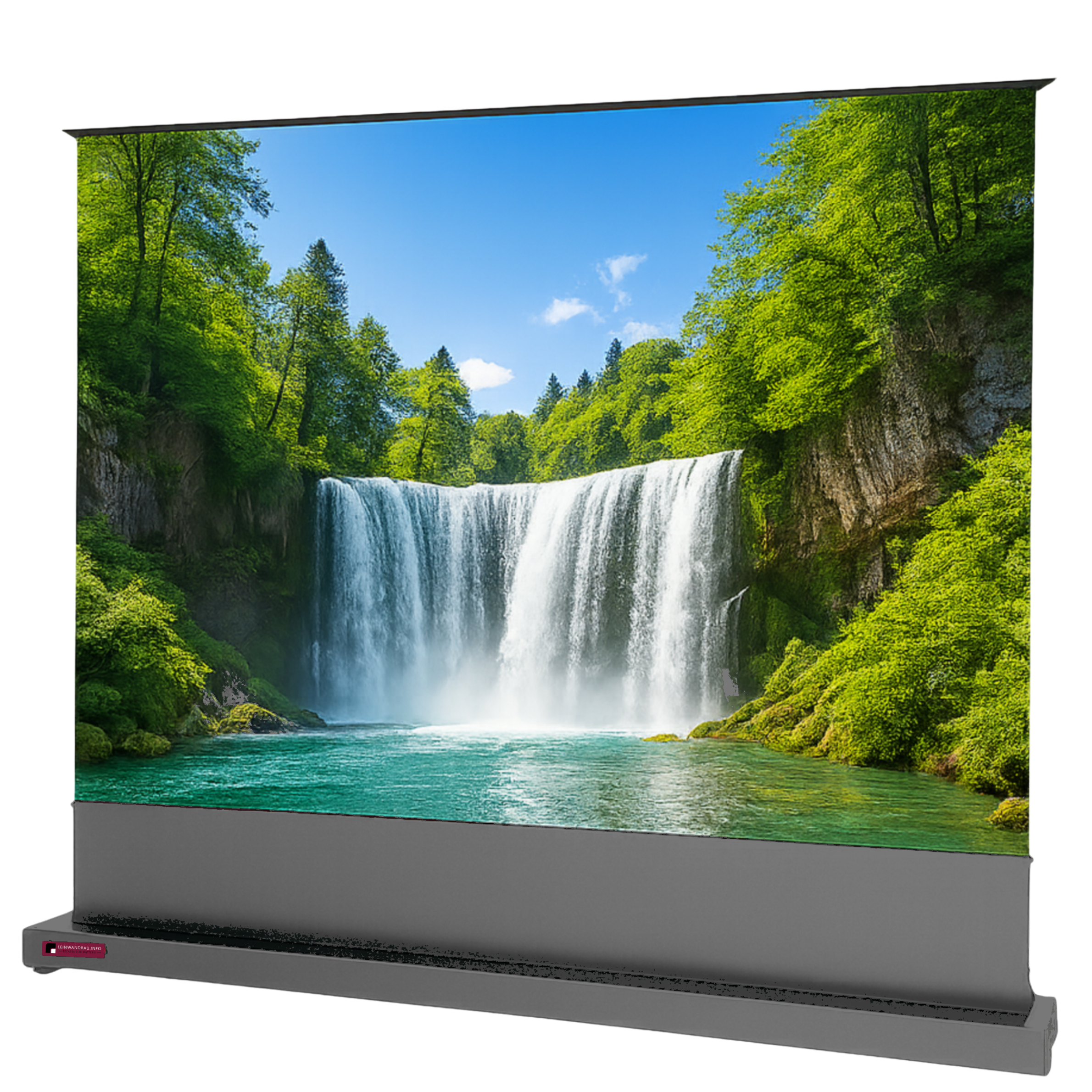
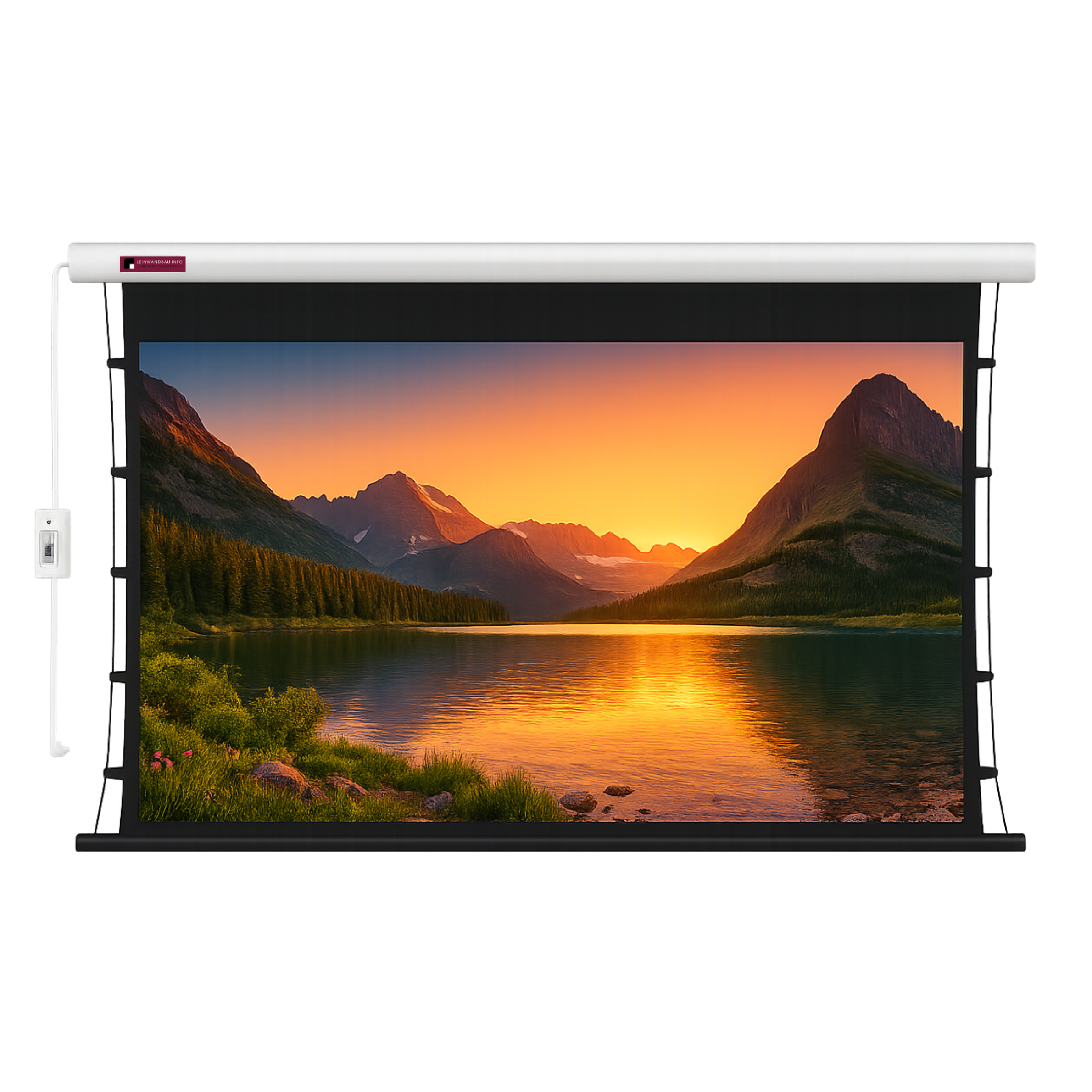
When purchasing such a 4k projector with screen package, you should primarily pay attention to the mechanical quality of the components. For dedicated cinema rooms, a stationary fixed-frame screen is usually recommended in the set for sharp edges, as it guarantees the best permanent flatness. If you want to integrate the system flexibly into your living room, a motorized tension screen in the bundle is the first choice, as the cable tensioning system permanently prevents unsightly waves. A perfectly put-together projector screen set not only saves you valuable research time but also, in most cases, offers a significant price advantage over purchasing the components individually.
Together to your perfect home theater
Setting up a perfect 4K home theater is a project that thrives on details. Every room situation, every incidence of light, and every desired image size requires individual consideration of the technical components. Don't leave your visual experience to chance or vague estimations. Leverage our years of expertise in high-end projection and let our specialists provide comprehensive and personalized support.
We will help you precisely analyze the characteristics of your room and find the optimal combination of a modern Ultra-HD projector and a high-contrast screen. Visit our showrooms or contact us directly by phone or email; together, we will create your tailor-made dream cinema that will delight you for years to come.
Frequently Asked Questions about 4K Projectors and Compatible Screens
Which screen is best for a 4k projector in a living room?
For a typical living room that cannot be
fully darkened, a contrast-enhancing ALR or
CLR screen is absolutely the best choice. These screens filter out distracting
ambient light, ensuring that your projector's black levels and color saturation
remain stable even with residual light in the room. If you have a dedicated, completely dark
cinema room, a classic matte-white screen with a gain of 1.0 is advantageous
due to its perfect color accuracy. You can find comprehensive details on this in our guide, which
helps you to choose the right screen.
What's the optimal viewing distance for a 120-inch 4K projection?
Thanks to the extremely high pixel density of
4K resolution, you can get much closer to the image than with older
Full-HD systems. With a screen diagonal of 120 inches (approx. 2.65 meters
net image width), the optimal viewing distance is between 3.20 and 3.80 meters.
In this range, you experience maximum immersion and perceive all fine
details without the beamer's pixel grid becoming visible to the eye
or the image uncomfortably overwhelming your field of vision.
What is the difference between a native 4K projector and pixel shifting?
A native 4K projector has an
imaging panel that is physically equipped with the full 8.3 million pixels (3,840
x 2,160). This ensures the absolute sharpest detail and maximum picture stability.
Pixel-shifting devices usually use a Full HD chip and move the mirrors with the help of an optical actuator
diagonally back and forth so quickly that for the human eye, the full number
of pixels is also displayed on the screen. This technology is extremely
mature and offers excellent value for money.
Can I use a 4K projector on a normal white wall?
Technically it is possible, but from the perspective of
picture quality, it is absolutely not recommended. A normal wall, even if
it is smoothly plastered, has fine structures and color nuances that
diffusely scatter light and break the sharpness of a 4K projection. In addition, a normal wall lacks the contrast-enhancing coating, which leads to a washed-out
picture with weak black levels. Only a specialized
projection screen will bring out the brilliance, contrast depth, and sharpness from your
high-end projector for which you have invested.